Part 5: Trauma and the Soul: Understanding Its Impact on Thoughts, Emotions, and Behaviours

By Susan Adeyemi, Counsellor, & Author

- Hope and Restoration
- Practical Indicators You Are Healing
- Ways to Overcome and Continue Healing:
- Reflection Questions
- Call to Action and Discussion Point
- Next Steps
- Summary of Series
- GET YOUR GUIDE ON MANAGING NEGATIVE EMOTIONS
- Related Articles
Hope and Restoration
Trauma affects the soul deeply, but it does not have to define your story. Healing is possible through:
- Acknowledgment and lament: Bringing your pain to God. Psalm 34:18 “The Lord is close to the broken-hearted and saves those who are crushed in spirit”.
- Renewing the mind: Using Scripture to replace lies with truth. Romans 12;2 “Do not conform to the patterns of this world, but be transformed by the renewing of your mind. Then you will be able to test and approves what God’s will is – his good, pleasing and perfect will.”
- Safe community and therapy: Processing trauma with wise support. Proverbs 11:14 “Where there is no counsel, the people fall; But in the multitude of counsellors, there is safety”.
- Inviting Jesus into your pain: Letting Him heal what was broken. Psalm 147:3 “He heals the broken-hearted and binds up their wounds.”
Statistics of Hope:
Studies show that trauma-informed counselling and faith-based community support significantly improve recovery outcomes, with over 70% reporting progress when actively engaging in therapy and spiritual practices (UK Trauma Council, 2023).
Biblical Promise:
“He restores my soul; He leads me in the paths of righteousness for His name’s sake.” (Psalm 23:3, NKJV)
Practical Indicators You Are Healing
- Increased self-awareness of triggers and responses.
- Ability to pause before reacting emotionally.
- Establishing boundaries in relationships without guilt.
- Experiencing emotional safety in relationships.
- Moving from fear-driven decisions to faith-led living.
Example Scenario:
Ruth, 45, after working with a Christian counsellor, learns to identify her fear of rejection when her husband is quiet. She now pauses, prays, and asks clarifying questions rather than withdrawing or lashing out.
Ways to Overcome and Continue Healing:
– Lament and process pain in God’s presence (Psalm 34:18).
– Regularly renew your mind with Scripture to replace lies with truth.
– Celebrate progress rather than perfection.
– Maintain supportive, faith-based community for encouragement.
– Seek the Holy Spirit’s help for inner healing (John 14:26).
Reflection Questions
- Which emotions do you find hardest to manage or acknowledge?
- Do you feel safe enough to bring your raw emotions before God?
Call to Action and Discussion Point
Call to Action:
Take time to journal how trauma may have affected your thoughts, emotions, and behaviours. Pray, asking God for courage to face these areas with Him. Consider seeking counsel or join my support group if you notice patterns affecting your relationships.
Discussion Invitation:
Have you experienced how past trauma shows up in your daily life and relationships? How has God been working to heal your soul? Share your thoughts and experiences in the comments to encourage others on their journey.
Next Steps
- Reflect on each part by writing in your journal.
- Share which part resonates most with you in the comments below.
- Download a copy of “Managing Negative Emotions Guide”
- Join my community to engage in prayers and accountability.
Book a free 30 minutes consultation with me (below) to unpack negative thinking patterns.
Summary of Series
| Part | Practical Indicators | Real-life Scenario | Ways to Overcome |
|---|---|---|---|
| 1: Understanding Trauma | Flashbacks, numbness, avoidance | Sarah panicking at raised voices | Awareness, grounding, Scripture, counselling |
| 2: Thoughts | Negative self-talk, hypervigilance | James fearing mistakes at work | Identify thoughts, renew mind, CBT, Scripture |
| 3: Emotions | Numbness, anxiety, shame | Laura fearing abandonment in silence | Naming emotions, prayer, safe relationships |
| 4: Behaviour | People-pleasing, isolation | Daniel overworking for approval | Recognise patterns, set boundaries, seek God’s approval |
| 5: Healing | Self-awareness, boundaries, faith-led choices | Ruth pausing before reacting | Lament, Scripture, celebrate progress, community |
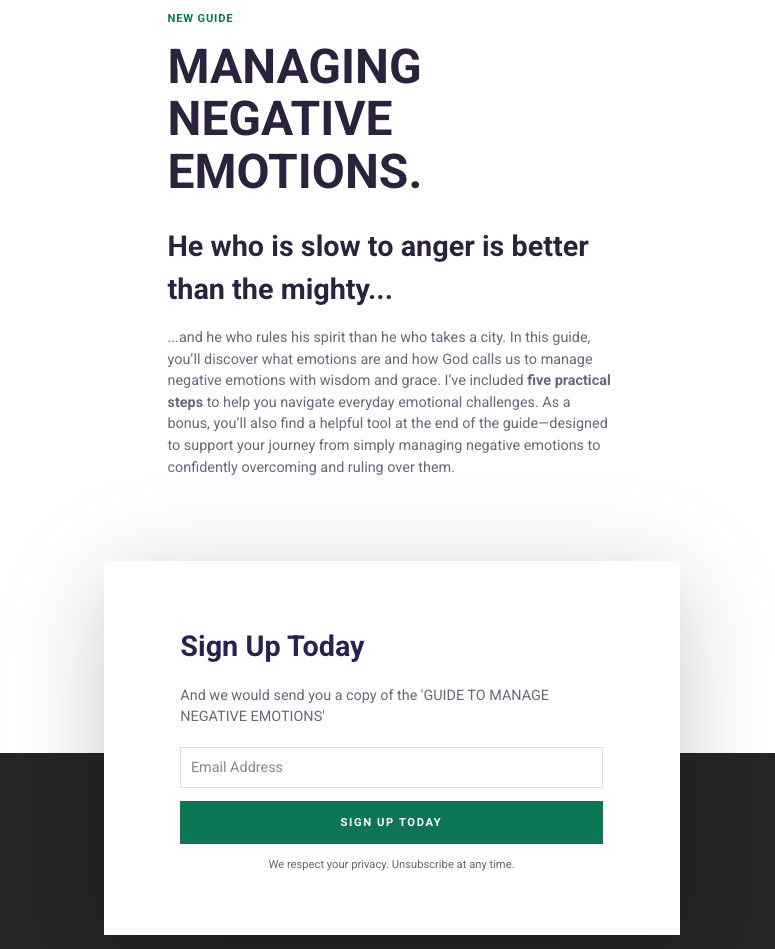
Use the GUIDE BELOW to evaluate your emotions. It also offers practical and biblical methods to manage negative emotions.
GET YOUR GUIDE ON MANAGING NEGATIVE EMOTIONS
Share your story in the comments and with others.
Your experience can bring light and encouragement to someone else navigating the same struggle. If this post helped you, share it with a friend who may be silently battling fear